
Home / Blogs / What Is a 5-Axis CNC Machine and Do You Really Need One?

What Is a 5-Axis CNC Machine and Do You Really Need One?

You’re looking at a complex part print with angled features, undercuts, and tight tolerances—and you’re wondering if your 3-axis mill can handle it without multiple setups. If you’ve been in that spot more than once lately, you’ve probably started asking whether a 5-axis CNC machine belongs in your shop. It’s a fair question, and the answer depends more on your actual work than the technology itself.
How 5-Axis Machining Actually Works

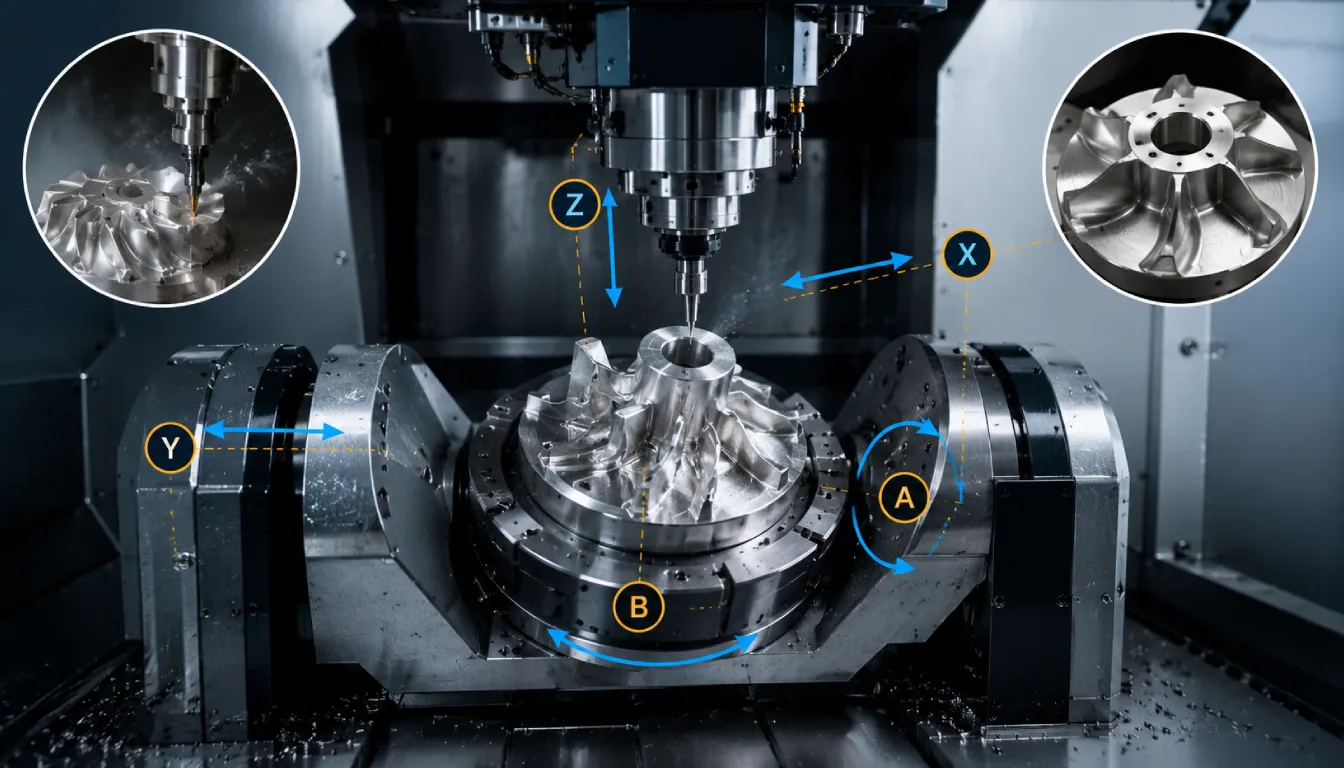
A 5-axis CNC machine moves the cutting tool along the standard X, Y, and Z axes—but it also rotates the part or toolhead on two additional rotational axes, typically called A and B (or sometimes A and C, depending on the configuration). This means you can approach the workpiece from virtually any angle without stopping to manually reposition it.

The real advantage isn’t just about what you can make. It’s about how many setups you can eliminate. Parts that would normally require three or four separate operations on a 3-axis machine can often be completed in a single setup on a 5-axis. That cuts down on fixturing time, reduces the chance of alignment errors between setups, and keeps your lead times shorter.

You’ll see two main types: trunnion-style machines, where the table tilts and rotates, and swivel-head designs, where the spindle moves on the rotational axes. Trunnion machines tend to be more rigid and better for heavy parts. Swivel-head machines offer better access and are often faster for smaller, intricate components.

When 5-Axis Actually Makes Sense for Your Shop

Not every shop needs five axes. If you’re running high-volume production of simple prismatic parts, you’re probably better off with a fast 3-axis VMC and good fixturing. But if you’re dealing with any of the following, a 5-axis CNC machine starts to pay for itself:

  • Aerospace or medical components with complex geometries and strict tolerances
  • Mold and die work where you need continuous surface machining without witness lines
  • Turbine blades, impellers, or other sculptured parts that require simultaneous multi-axis motion
  • Prototype and job shop work where flexibility matters more than cycle time
  • Parts with deep pockets or angled features that would otherwise require custom tombstones or angle plates

The math changes when you factor in setup time. If a part takes 20 minutes to machine but an hour to fixture across multiple setups, you’re losing money even if your machine cost less up front.

What to Look for When Buying Used 5-Axis Equipment

Buying a used 5-axis CNC machine can save you 40-60% compared to new, but you need to know what you’re inspecting. The rotary axes are where most of the wear shows up. Check backlash on the A and B axes, and ask for spindle hour logs if they’re available.

Control type matters more on 5-axis than it does on simpler machines. Older Fanuc, Siemens, and Heidenhain controls handle simultaneous 5-axis toolpaths well, but you’ll want to confirm your CAM software can post to whatever control is on the machine. Some older Haas controls, for example, are 3+2 positioning only—not true simultaneous 5-axis.

Don’t skip the test cut if you’re serious about a machine. Run a ball bar test or at least a circular interpolation test on the rotary axes. You’re looking for smooth motion, no stalling, and consistent surface finish across different orientations.

Common Mistakes Buyers Make with 5-Axis Machines

The biggest mistake is buying 5-axis capability you’ll never use. If you’re only doing 3+2 positioning work—where the rotary axes lock in place and you mill with three axes—you might not need full simultaneous motion. That’s still valuable, but it’s a different class of machine and a different price point.

Another issue: underestimating the programming learning curve. 5-axis CAM isn’t dramatically harder than 3-axis, but it does require training and practice. If your programmers aren’t ready, the machine will sit idle while you figure it out.

And don’t forget about toolholders and workholding. You’ll need shorter tools to avoid collisions, which sometimes means HSK or shrink-fit holders instead of CAT40. Your existing vises and fixtures might not work, especially if you’re moving to a trunnion-style table.

Summary

  • A 5-axis CNC machine adds two rotational axes to standard 3-axis motion, letting you machine complex parts in fewer setups
  • It makes the most sense for aerospace, medical, mold/die, and job shops handling sculptured or angled geometries
  • Used machines offer serious savings, but inspect the rotary axes carefully and confirm control compatibility with your CAM system
  • The real cost isn’t just the machine—it’s tooling, workholding, and the time your team needs to get up to speed

If you’re evaluating whether 5-axis belongs in your operation, MachineStation’s team can help you source the right equipment and talk through what actually fits your work—not just what sounds impressive on paper.

FAQs:

1. What is the difference between 3-axis and 5-axis CNC machining?

A 3-axis CNC machine moves the cutting tool along X, Y, and Z axes, which works well for flat or simple parts. A 5-axis CNC machine adds two rotational axes (A and B), allowing the tool or workpiece to tilt and rotate. This enables machining of complex geometries, angled features, and undercuts in a single setup—reducing setup time, improving accuracy, and eliminating the need for multiple fixtures.

It depends on your work. If you regularly machine aerospace components, medical implants, turbine blades, mold cores, or parts with complex contours and tight tolerances, a 5-axis machine can significantly reduce setup time and improve part quality. However, if your work is primarily 2.5D parts, simple prismatic components, or high-volume production of flat parts, a 3-axis or 4-axis machine is usually more cost-effective. Evaluate your current job mix, setup bottlenecks, and future opportunities before investing.

Used 5-axis CNC machines typically range from $75,000 to $400,000+, depending on brand, model, size, control type, spindle hours, and condition. Entry-level trunnion-style machines (like used Haas UMC series) start around $75,000–$150,000. Mid-range machines (DMG MORI, Mazak, Okuma) run $150,000–$300,000. High-end simultaneous 5-axis machines with large tables and advanced controls can exceed $400,000. MachineStation offers inspected used 5-axis machines with transparent pricing, financing options, and technical support. Call +1-909-919-9600 for current inventory and quotes.

Quick Contact

Please enable JavaScript in your browser to complete this form.
Are you a Reseller?

Back to Top
Select Language
Product has been added to your cart