Home / Blogs / CNC Machine Repeatability vs Accuracy: Why Both Matter

CNC Machine Repeatability vs Accuracy: Why Both Matter

When doing CNC machining work, the operator needs to take care of two major factors: one is that the accuracy of the manufactured product’s dimensions is properly achieved, and the repeatability of different products’ tolerances is achieved when doing high volume production work. But they are very different from each other, yet plays very important role together in achieving the right precision of the products being machined. Understanding the proper differences between CNC repeatability vs accuracy is very important for manufacturers to do manufacturing with fewer scraps and more profit. 
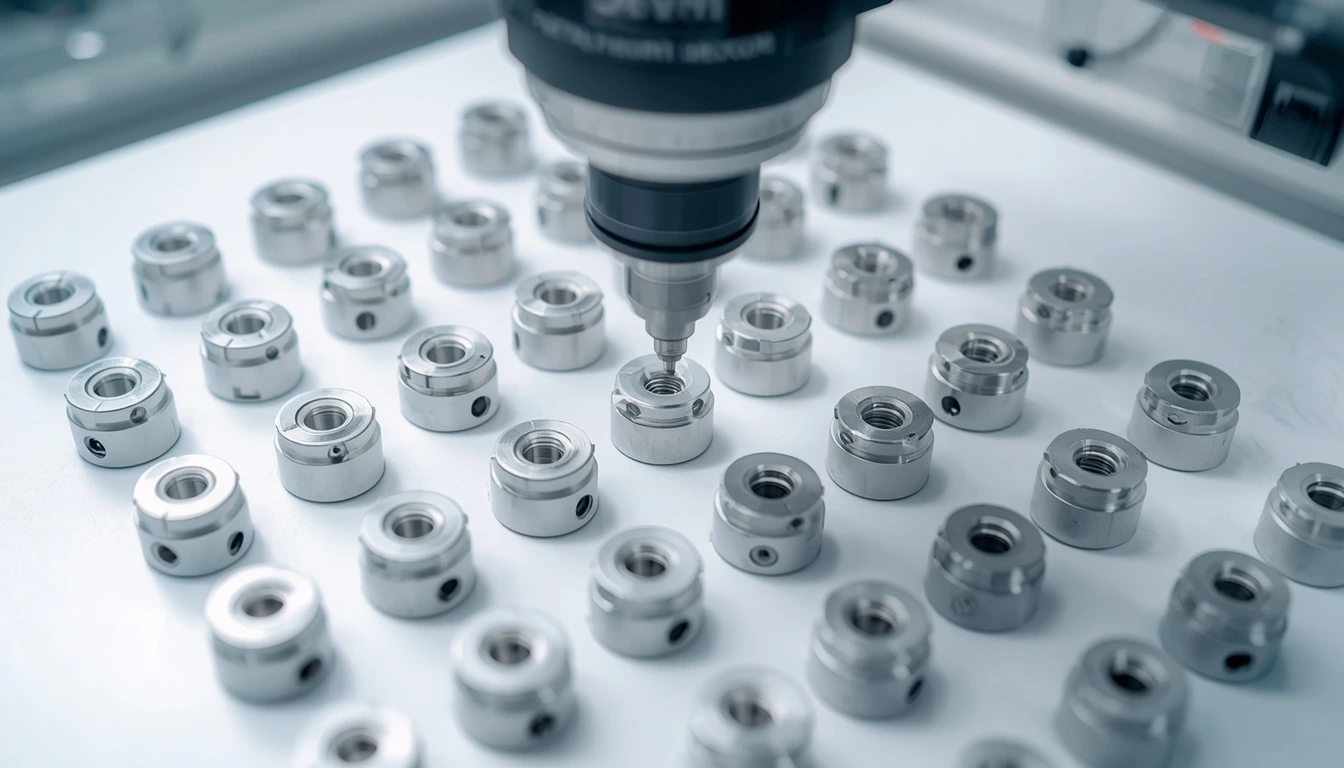
CNC Machine Repeatability vs Accuracy Why Both Matter

What is CNC Machine Accuracy?

CNC machine accuracy refers to how close a machine can position a tool or part to the intended coordinate. In easy terms, it helps in answering the question: Does the machine hit the exact programmed location?

If a program commands a tool to move to X = 100.000mm, accuracy determines how close the machine actually gets to that position. 

Here are the major factors on which accuracy depends:

  • Thermal stability
  • Ball screw condition
  • Calibration and compensation settings
  • Axis alignment

What is CNC Machine Repetability?

Now, in CNC repeatability vs accuracy, we need to discuss what CNC machine repeatability is. Repeatability refers to how consistently a machine can return to the same position over multiple attempts.

It answers a different question: can the machine hit the same spot again and again? For example, if a machine constantly reaches X = 99.98mm instead of 100.00mm, but does it the same way every time, then it has strong repeatability but limited capacity. 

Repeatability is often more stable than accuracy because it depends less on absolute positioning and more on consistency in motion. 

Accuracy vs Repeatability – Core Differences:

The differences between these two concepts of CNC repeatability vs accuracy are subtle but different.

  • Accuracy means closeness to the true value
  • Repeatability means consistency of results

A CNC machine can be:

  • Accurate but not repeatable
  • Repeatable but not  accurate
  • Both accurate and repeatable
  • Neither accurate nor repeatable

Why Repeatability is Often More Critical?

When doing precision CNC machining works, repeatability is frequently considered more important than the actual accuracy of the CNC machine. This is because repeatability depends on the fundamental mechanical unit and the build quality of the CNC machine. If a machine is repeatable, then its errors are predictable. 

If your CNC machine is constantly “off” by 0.02mm, you can use software offsets or tool compensation to fix the part. But if the machine is not repeatable, the error is random. You cannot easily “tune out” a machine that never lands in the same space twice. 

Why Accuracy Still Cannot be Ignored?

Accuracy determines how closely your parts match the intended design. If accuracy is too far off, even consistent results will not meet dimensional requirements. Accuracy becomes critical in:

  • Tight tolerance components
  • Precision mating components
  • Aerospace and medical parts

How do CNC Manufacturers Specify these Values?

Machine specifications typically list both accuracy and repeatability, but they are measured differently. 

  • Accuracy is often measured using laser calibration systems
  • Repetability is tested through repeated positioning cycles

Repeatability values are usually tighter than accuracy values. 

Common Causes of Poor Accuracy:

Here are the major sources from which accuracy issues can arise:

  • Thermal expansion
  • Mechanical wear
  • Encoder drift
  • Improper leveling

In several cases, the accuracy can be improved through:

  • Software compensation
  • Mechanical adjustments
  • Calibration

Common Causes of Poor Repeatability:

Causes of repetability are often more serious. The common causes include:

  • Loose couplings
  • Guideway wear
  • Backlash in ball screws
  • Servo inconsistencies

These factors affect the machine’s ability to return to the same position reliably. 

How to Test Accuracy in a Used CNC Machine?

The accuracy of a used CNC machine can be tested using:

  • Test cuts
  • Dial indicators
  • Laser measurement systems

Also, a common method is positioning the machine at a known coordinate and measuring deviation. 

How to Test Repeatability in a Used CNC Machine?

Repeatability testing involves repeating the same movement multiple times, and the steps include:

  • Move the axis to a position
  • Return to home
  • Move back to the same position
  • Measure variation

Minimal variation indicates good repeatability. 

Balancing Both for Better Machining Outcomes:

An ideal CNC machine is capable of maintaining both acceptable accuracy and strong repeatability. A balanced machine helps with:

  • Reliable production
  • Consistent part quality
  • Minimal manual adjustments

The balancing of these two CNC performance metrics will help with better precision CNC machining results. 

Now, if you are interested in buying a used CNC machine, then check our collection of used CNC machines. 

Conclusion: 

Both repeatability and accuracy are important for proper precision machining work by a CNC machine, and a manufacturer needs to take care of different practices and metrics to ensure that both are properly available in their CNC machine. 

FAQs:

1. What is the difference between accuracy and repeatability in CNC machines?

Accuracy refers to how close the machine gets to the programmed position, while repeatability measures how consistently it reaches the same position over multiple attempts. Both describe different aspects of machine performance.

Repeatability often has a greater impact on production because consistent results allow operators to maintain stable machining processes. However, acceptable accuracy is still required to meet dimensional requirements. 

Modern control systems include compensation features that help improve positioning. However, they cannot fully compensate for significant mechanical wear or instability.

Back to Top
Select Language
Product has been added to your cart