Home/Blogs/Haas vs Mazak CNC Machines: Which Brand Fits Your Production Goals?
Haas vs Mazak CNC Machines: Which Brand Fits Your Production Goals?
You’re ready to add a machining center to your shop, and the Haas vs Mazak debate keeps coming up. Both brands dominate used CNC inventory, but they serve different priorities — and choosing the wrong one can mean workflow headaches or budget overruns you didn’t plan for.
What Separates Haas and Mazak in Real-World Performance
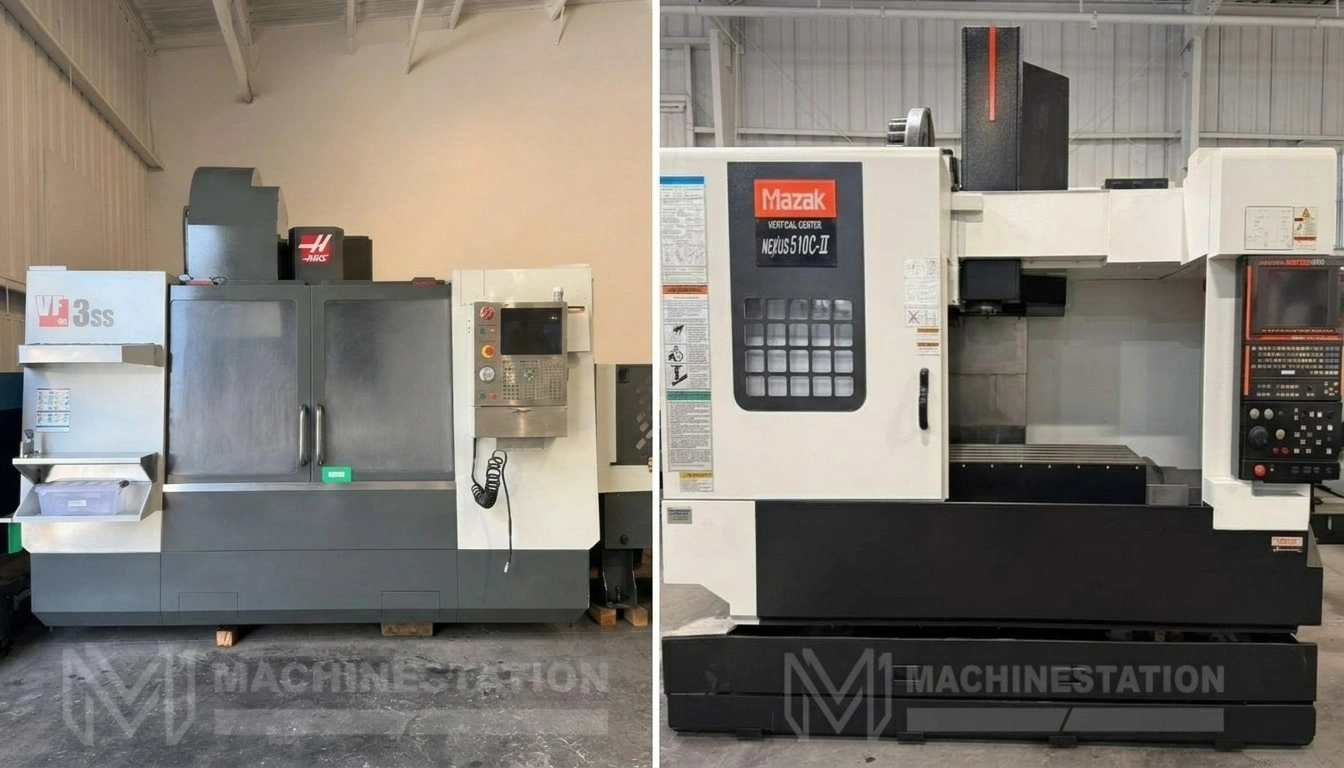
Haas built its reputation on accessible, no-nonsense vertical and horizontal machining centers that get the job done without exotic price tags. You’ll find Haas controls on everything from job shops running short batches to schools training the next generation of machinists. The proprietary Haas control is straightforward — most operators pick it up in a few days.
Mazak machines lean toward higher-end production environments where speed, rigidity, and multi-tasking capability justify the premium. Mazak offers both Fanuc and Mazatrol controls, giving you flexibility depending on what your team already knows. If you’re running lights-out production or need a mill-turn center that handles complete parts in one setup, Mazak’s engineering shows up in cycle time and part consistency.
The Haas vs Mazak choice often comes down to this: Haas optimizes for value and simplicity. Mazak optimizes for throughput and complexity.
Price Points and What You Actually Get
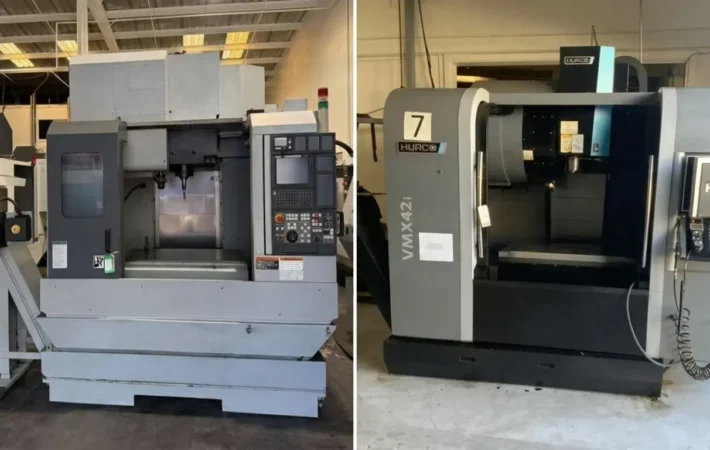
A used Haas VF-2 from the mid-2010s typically runs $25,000–$45,000 depending on hours and condition. You’re getting a 30″ x 16″ x 20″ work envelope, 7,500 RPM spindle, and a control that won’t confuse your second-shift operator.
Comparable Mazak verticals — say, a VCN-530C — start closer to $50,000–$80,000 used, but you’re also getting faster rapids, heavier castings, and often better thermal stability. That matters if you’re holding ±0.0005″ on production runs.
Here’s what the price difference buys you:
Rigidity: Mazak machines usually handle interrupted cuts and hardened materials with less chatter
Speed: Rapid traverse rates on Mazak often hit 1,417 IPM vs. Haas’s 1,000 IPM on similar models
Tooling capacity: Mazak typically offers larger tool magazines and faster tool-change times
Resale value: Mazak machines hold value longer in high-mix, high-volume markets
If your shop runs aluminum brackets and fixture plates, Haas delivers without the premium. If you’re cutting titanium aerospace components or need to justify ROI on a $200K annual contract, Mazak’s performance edge pays back faster.
Control Systems and Operator Training
Haas uses its own control exclusively. It’s intuitive, graphical, and easy to troubleshoot — but it’s also proprietary. If your team knows Fanuc, there’s a learning curve. Most shops adapt quickly, but it’s worth considering if you’re hiring experienced machinists who’ve never touched a Haas.
Mazak gives you options. Mazatrol conversational programming is powerful for complex parts, especially if your programmers work directly at the machine. Fanuc controls are industry-standard, so finding qualified operators is easier. You can even spec machines with both controls if you’re buying new, though used inventory usually comes with one or the other.
The real question: does your team already have CNC experience, or are you training from scratch? Haas is easier to onboard. Mazak rewards expertise.
Common Mistakes When Comparing These Brands
Don’t assume “Japanese-made” automatically means better. Haas manufactures in California with tight quality control, and their service network is one of the best in North America. Mazak’s global footprint is strong, but parts availability and service response vary by region.
Ignoring spindle hours and maintenance records is the bigger mistake. A well-maintained Haas with 8,000 hours will outperform a neglected Mazak with 3,000 hours. Always ask for inspection reports, tooling inventories, and service history before you commit.
Also, don’t forget about toolholders, workholding, and fixturing. Haas machines often use CAT40 or BT30 tapers. Mazak leans toward BT40 or HSK on newer models. If you’re switching brands, you might need to rebuild your tooling library — budget for it.
Summary
Haas excels in value, ease of use, and broad service support — ideal for job shops and general machining
Mazak delivers higher speeds, rigidity, and multi-tasking capability for production-focused environments
Control preference matters: Haas proprietary vs. Mazak’s Fanuc or Mazatrol options
Condition trumps brand: spindle hours, maintenance records, and inspection results matter more than the nameplate
Whether you’re comparing Haas vs Mazak for your first machine or your fifteenth, MachineStation’s used inventory gives you access to both brands with transparent specs and real machine histories.
FAQs:
1. Which brand is better for high-volume production runs?
Mazak machining centers are typically better suited for high-volume production environments. Mazak’s rapid traverse rates, advanced automation options (like pallet changers and robot integration), and high-speed spindle configurations are designed for lights-out manufacturing and continuous operation. Haas machines excel in job shop flexibility and cost efficiency, but Mazak’s engineering prioritizes throughput and uptime in dedicated production cells. If your shop runs the same parts repeatedly at scale, Mazak’s speed and automation ecosystem will deliver faster cycle times and higher daily output.
2. Are Haas CNC machines easier to service than Mazak?
Yes, Haas machines are generally easier and less expensive to service. Haas uses standardized components, widely available replacement parts, and a large North American service network with factory-direct support. Mazak machines often require OEM-specific parts, specialized technician training, and longer lead times for components—especially for older or discontinued models. For shops without dedicated in-house CNC maintenance staff, Haas offers lower service complexity and faster turnaround on repairs, which translates to less downtime and lower long-term maintenance costs.
3. How much more does a used Mazak cost compared to a used Haas?
Used Mazak machining centers typically cost 20–40% more than comparable used Haas models with similar specifications, age, and condition. For example, a used Haas VF-4 might sell for $40,000–$60,000, while a used Mazak VCN-530C with similar table size and spindle specs could range from $60,000–$90,000. The premium reflects Mazak’s higher build quality, faster rapids, advanced control features, and stronger resale value. However, the price gap narrows for older machines or models with high spindle hours. Buyers should weigh the upfront cost difference against expected throughput gains, tooling compatibility, and long-term service expenses.