Home / Blogs / Used Multi-Axis CNC Machines: Which Capabilities Does Your Shop Need?

Used Multi-Axis CNC Machines: Which Capabilities Does Your Shop Need?

A multi-axis CNC machine can expand what your shop is capable of producing—but buying the machine with the most axes is not automatically the right decision. The real question is whether its capabilities match the parts you manufacture, the materials you cut, and the number of setups your production requires.

When comparing used multi-axis CNC machines, focus on the operations you need to complete, not simply the axis count. A well-matched 4-axis machine may be more practical for your shop than a more complex 5-axis system.

Start With the Parts You Manufacture

Before comparing machines, review a few representative part drawings from your regular production.

Ask yourself:

  • Do parts require machining on multiple sides?
  • Are there angled holes, curved surfaces, or complex contours?
  • Can the workpiece be completed in one setup, or does it need repeated repositioning?
  • Are you machining individual components, small batches, or repeat production runs?
  • Do your parts require both turning and milling?

These answers help identify the multi-axis CNC capabilities that can actually improve your workflow.

Which Multi-Axis Configuration Fits Your Work?

Instead of choosing by axis count alone, compare the following configurations against your production requirements.

ConfigurationWhat it can help withConsider it when
4-axis machiningRotary positioning and machining around multiple sidesParts need additional access beyond standard 3-axis machining
3+2 machiningPositions the workpiece at different angles before cuttingYou need angled machining but not continuous simultaneous movement
Simultaneous 5-axisCoordinates five axes during cuttingParts have complex contours, changing tool angles, or demanding surface geometry
Mill-turn / multi-taskingCombines turning and milling operations in one machine platformComponents require both rotational and milling operations

The actual functions depend on the machine model, rotary-axis arrangement, control, software, and installed options. Always confirm the specific configuration.

Four Production Situations to Consider

1. Your Parts Need Machining on Multiple Sides

If operators repeatedly remove, reposition, and reclamp a component, a 4th-axis rotary table or indexer may help reduce manual repositioning.

This can be useful for components with features distributed around their circumference. However, check the rotary unit’s size, load capacity, mounting arrangement, and compatibility with the machine.

2. Your Parts Have Angled Features

A 3+2 configuration can position a part at different angles and then perform machining with the linear axes. It may suit components with multiple angled faces where continuous five-axis movement is not required.

Confirm whether the machine has the required rotary axes, positioning capability, and control functions. A machine described as “5-axis ready” may not include every component needed for full operation.

3. Your Parts Have Complex Curved Surfaces

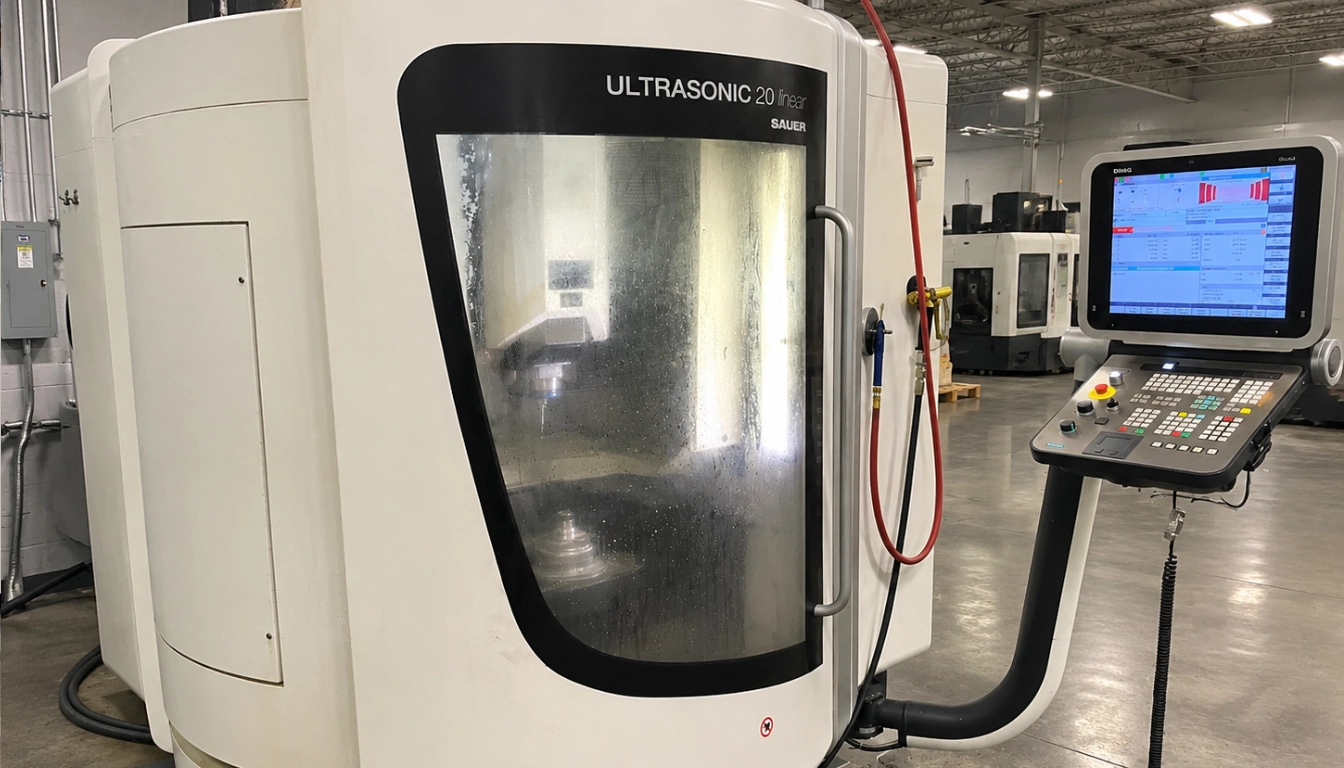
Simultaneous 5-axis machining can be valuable for complex surfaces, contoured components, and applications where the cutting tool needs to maintain a changing orientation.

Before choosing a used 5 axis CNC machine, verify the exact simultaneous machining capability, control configuration, software compatibility, and postprocessor requirements. The presence of two rotary axes alone does not establish that every five-axis function is available.

4. Your Components Need Turning and Milling

Some multi-tasking CNC lathes combine turning with milling functions. Depending on the configuration, features such as a Y-axis, C-axis, live tooling, or sub-spindle can support multiple operations on a component.

For these machines, check the turret or milling head configuration, spindle arrangement, tool capacity, and the operations supported by the installed control.

What to Verify Before Buying Used Equipment

Once you identify the required capability, evaluate the actual machine—not just its advertised axis count.

Check these details:

  • Axis configuration: Identify every linear and rotary axis and confirm which movements are available.
  • Simultaneous versus positional operation: Establish whether the machine supports the motion your parts require.
  • CNC control: Confirm the control model, installed options, programming workflow, and compatibility with your CAM software.
  • Rotary table and trunnion: Review dimensions, load capacity, positioning, and available documentation.
  • Spindle and tooling: Match spindle speed, power, taper, and tool capacity to your materials and cutting tools.
  • Machine condition: Ask about operating hours, maintenance records, service history, alarms, and current operating status.
  • Included equipment: Confirm which rotary units, probes, tooling, software options, and accessories are included in the quotation.

For more detail, read our guides on used CNC machine control systems, operating hours, and maintenance history.

Find a Machine That Matches Your Production

The right multi-axis machine is the one that can handle your actual components without adding unnecessary complexity to your operation.

Explore MachineStation’s used multi-axis CNC machine inventory and used 5-axis CNC machines. You can also browse the complete used CNC machine inventory.

If you are unsure which configuration fits your parts, contact MachineStation with your application requirements and the machine capabilities you need.

FAQs:

1. What are used multi-axis CNC machines?

Axis travel, table dimensions, maximum table load, spindle taper, spindle speed, tool magazine capacity, control system, and machine condition are important factors.

They use different spindle tooling interfaces. A 40-taper configuration is common in general machining, while 50-taper machines are often selected for heavier tooling and certain demanding cutting applications.

Not necessarily. Fourth-axis readiness does not always mean a rotary table is included or that all required control and hardware options are installed.

It depends on the materials, cutting tools, cutter diameter, and machining strategy. Higher RPM is useful for certain applications but is not always necessary.

Back to Top
Select Language
Product has been added to your cart
Max · MachineStation
Looking for a machine? I can check live inventory for you. 👋